Your Full-scale Guide to Secure Platform Connection
Learn how to safely access BlackOps Market through Tor hidden services. Complete setup instructions covering VPN layering, browser hardening, and operational security fundamentals for anonymous darknet navigation.
Official mirrors verified for maximum security and uptime
Always verify these addresses through official channels. Beware of phishing attempts.
Step-by-step instructions for establishing your first secure connection
The only legitimate source for Tor Browser is the official Tor Project website. Third-party download portals, file-sharing platforms, and app stores frequently distribute tampered versions containing surveillance payloads or cryptocurrency-stealing malware. After downloading the installer for your operating system, verify the cryptographic signature using the Tor Project's signing key before proceeding with installation. On Windows, run the installer and choose a directory that does not require administrative privileges. On Linux, extract the tarball and execute the start-tor-browser script from the extracted directory. macOS users should drag the application to the Applications folder after mounting the disk image.
Immediately after launching Tor Browser for the first time, click the shield icon in the toolbar and set the security level to "Safest." This configuration disables JavaScript execution on all non-HTTPS sites, blocks certain font rendering mechanisms that can be exploited for fingerprinting, prevents media auto-play, and restricts several potentially dangerous browser features. BlackOps Market is engineered to function fully at this maximum security setting, so you sacrifice no marketplace functionality while gaining the strongest possible browser-level protection against exploitation attempts.
Tor Browser ships with the NoScript extension pre-installed. When the security level is set to Safest, NoScript blocks all JavaScript globally by default. Avoid adding per-site exceptions unless absolutely necessary, as each exception expands your attack surface and contributes to a unique browser fingerprint. Never resize the Tor Browser window from its default dimensions, as window size is one of the most reliable fingerprinting vectors. Refrain from installing additional extensions, changing default fonts, or modifying any about:config preferences — each modification makes your browser instance distinguishable from the millions of standard Tor Browser installations in the network.
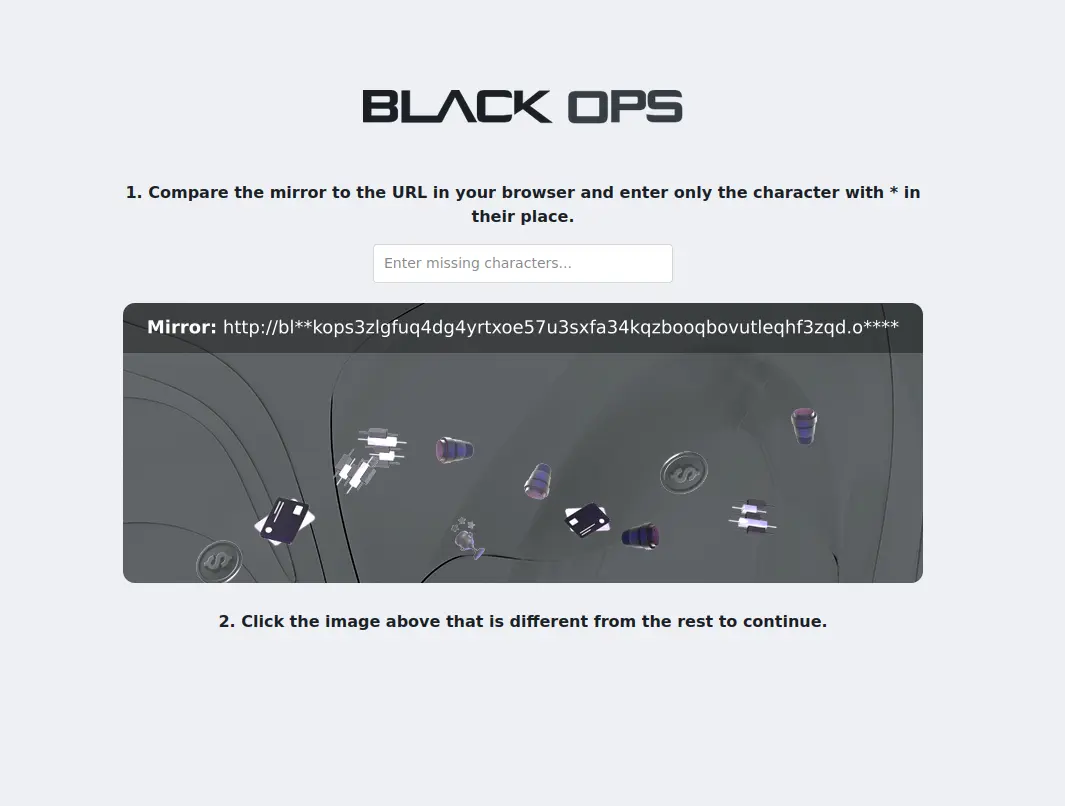
With Tor Browser configured, copy one of the verified onion addresses from the mirror section above. Paste it directly into the address bar and press Enter. The initial connection establishment typically requires 10 to 30 seconds as Tor constructs a six-hop circuit through the relay network to reach the hidden service. When the login page loads, inspect the address bar carefully to confirm it matches the address you entered character by character. Look for BlackOps Market's anti-phishing verification challenge — a visual CAPTCHA unique to the genuine service. If anything appears unusual, such as missing interface elements, unexpected credential requests, or layout inconsistencies, close the tab immediately and attempt connection through an alternative mirror.
After successfully reaching BlackOps Market, bookmark the verified address in Tor Browser for future sessions. Enable PGP-based two-factor authentication through the account security settings to protect against credential theft. Generate a dedicated 4096-bit RSA key pair using GnuPG exclusively for your marketplace identity. Upload your public key to your profile and test the decryption challenge to confirm proper configuration. Store your marketplace credentials in KeePassXC using a strong master passphrase rather than relying on memory or unencrypted notes.
For maximum operational security when accessing BlackOps Market, consider using a dedicated privacy-focused operating system rather than your everyday desktop environment. Tails OS is an amnesic live system that boots from USB media, routes all network traffic through Tor by default, and leaves absolutely no forensic traces on the host machine after shutdown. For users who prefer a persistent environment, Whonix provides a dual virtual machine architecture that isolates your browsing activity from your host operating system, making IP leaks architecturally impossible even if the workstation is compromised. Both systems represent significant security improvements over running Tor Browser on a standard Windows or macOS installation, where background processes, automatic updates, and system telemetry can inadvertently compromise your anonymity. Encrypt your boot media using VeraCrypt volumes to protect any persistent storage from physical examination. Review the Electronic Frontier Foundation guidelines on digital self-defense and consult Privacy Guides for current recommendations on privacy-respecting software configurations. Managing your cryptographic keys with OpenPGP compliant tools ensures interoperability across all platforms that support PGP-based authentication.

VPN integration strategies and DNS leak prevention for anonymous connectivity
The recommended configuration for BlackOps Market access is Tor-over-VPN, where you connect to a VPN first and then launch Tor Browser. This topology hides your Tor usage from your internet service provider, which is critical in jurisdictions where Tor traffic is flagged or throttled. The VPN server sees that you are connecting to Tor entry nodes but cannot decrypt the traffic content. The reverse configuration — VPN-over-Tor — routes VPN traffic through the Tor network, which is significantly more complex to configure and provides marginal additional benefit for marketplace access scenarios. For the vast majority of users, Tor-over-VPN delivers the optimal balance between anonymity enhancement and configuration simplicity.
Choose a VPN provider that accepts Monero or other cryptocurrency payments to avoid linking your payment identity to the VPN account. Prioritize providers that have undergone independent no-log audits from reputable cybersecurity firms, operate under jurisdictions outside the Fourteen Eyes intelligence-sharing alliance, and support WireGuard or OpenVPN protocols with strong cipher suites. Verify that the provider offers a network-level kill switch that terminates all internet connectivity if the VPN tunnel drops unexpectedly, preventing accidental clearnet exposure of your Tor traffic.
DNS leaks represent one of the most common anonymity failures during darknet access. Even with a VPN active, misconfigured systems may route DNS queries through the ISP's default resolver, revealing the domains you are attempting to resolve. Configure your VPN client to use its own DNS servers exclusively, and verify leak protection using online DNS leak testing tools before connecting to any marketplace. Enable the VPN kill switch feature in the client settings — this firewall-level mechanism blocks all network traffic if the VPN connection drops, ensuring that no packets leave your system over the unprotected connection. On Linux systems, supplement the VPN kill switch with iptables rules that restrict outbound traffic exclusively to the VPN tunnel interface.
Two frequently overlooked leak vectors can compromise your anonymity even when VPN and Tor are properly configured. IPv6 traffic often bypasses VPN tunnels entirely because many VPN clients only route IPv4 traffic through the encrypted tunnel. Disable IPv6 at the operating system level before initiating marketplace sessions — on Linux, add net.ipv6.conf.all.disable_ipv6 = 1 to your sysctl configuration. WebRTC, a browser API for real-time communication, can expose your local and public IP addresses through STUN requests that bypass proxy settings. While Tor Browser disables WebRTC by default, verify this protection remains active by checking the media.peerconnection.enabled preference in about:config — it should be set to false.
For users requiring the highest level of network isolation, the Whonix operating system provides a dual-VM architecture that makes IP leaks architecturally impossible. The Whonix Gateway VM handles all Tor routing, while the Whonix Workstation VM runs your applications in complete network isolation — even if the workstation is fully compromised, it physically cannot communicate with the internet except through the gateway's Tor connection. This hardware-enforced isolation eliminates entire categories of leak vulnerabilities that software-only solutions cannot address, making it the recommended environment for regular BlackOps Market access.
Six foundational pillars protecting your identity during marketplace interactions
Dedicate Tor Browser exclusively to marketplace activity. Never use it for personal browsing, social media, or any activity connected to your real identity. Each browsing context creates correlation opportunities that sophisticated traffic analysis can exploit to link anonymous sessions with identified users across separate browsing instances.
Avoid establishing predictable access patterns by varying your connection times and session durations. Tor circuits provide anonymity at the network layer, but temporal correlation attacks can link your sessions if you consistently access BlackOps Market at the same time each day from the same network environment.
Use separate Tor Browser instances or the New Identity feature between different marketplace activities. Compartmentalizing browsing, messaging, and financial transactions into isolated sessions prevents cross-contamination of behavioral metadata that could be used to construct a complete activity profile.
Encrypt your entire storage device using VeraCrypt or LUKS full-disk encryption. Disable Bluetooth, location services, and all unnecessary network interfaces before initiating marketplace sessions. Consider using a dedicated device or bootable USB environment like Tails OS that leaves no forensic traces.
Generate unique, high-entropy passwords for every marketplace account using a local password manager. Never reuse credentials from clearnet services. Rotate your marketplace password every 60 days and immediately change it if you suspect any compromise. Enable PGP-based two-factor authentication as an additional verification layer.
Strip EXIF data, GPS coordinates, and embedded device identifiers from any files before uploading or sharing through marketplace channels. Images captured by smartphones contain extensive metadata including camera model, software version, and precise geolocation that can directly identify the originating device and its owner.
Understanding the exclusive cryptocurrency requirement for BlackOps Market transactions
BlackOps Market operates as a Monero-only platform because XMR provides cryptographic privacy guarantees that no other major cryptocurrency can match. Unlike Bitcoin, where every transaction is permanently recorded on a transparent public ledger, Monero employs ring signatures to obscure the sender, stealth addresses to hide the receiver, and RingCT to conceal transaction amounts. This triple-layer privacy architecture ensures that marketplace transactions cannot be traced, linked, or surveilled by blockchain analysis firms or law enforcement agencies monitoring public ledger activity.
Avoid purchasing XMR directly from centralized exchanges that require KYC identity verification, as this creates a permanent link between your identity and your Monero holdings. Instead, acquire Monero through peer-to-peer platforms that accept cash payments, use decentralized atomic swap services to convert Bitcoin or other cryptocurrencies into XMR without intermediaries, or find local Monero sellers who accept cash through privacy-focused trading communities. Each acquisition method carries different trade-offs between convenience, exchange rates, and anonymity preservation.
Wallet Setup for Marketplace Deposits
Real-time pricing for privacy-focused and major cryptocurrencies
Fundamental tools and references for secure BlackOps Market access
Security Warnings and Anti-Phishing Guidelines
Phishing Attack Prevention
Account Protection Measures
Connection Security Protocol
BlackOps Market Interface Gallery
Verified screenshots of the authentic platform interface
BlackOps Access FAQ
Answers to common questions about connecting and troubleshooting
How do I configure a VPN for BlackOps Market access?
A VPN is optional but adds a layer of protection by hiding Tor usage from your ISP. Connect to the VPN first, then launch Tor Browser (VPN → Tor configuration). Choose a provider that accepts cryptocurrency and keeps no logs. Avoid free VPNs — they monetize your data. Note that VPN-over-Tor (Tor first, then VPN) is not recommended as it can expose your traffic at the VPN exit node.
Why does BlackOps Market load slowly through Tor?
Tor routes your traffic through three relays worldwide, which inherently adds latency. BlackOps Market also runs JavaScript-free by design, which eliminates some client-side optimizations. If pages take more than 30 seconds, request a new Tor circuit. Peak hours (18:00-02:00 UTC) experience higher traffic. Try connecting during off-peak times or switch to a less congested mirror from the verified list.
What operating system is safest for accessing BlackOps Market?
Tails OS is the recommended option — it routes all traffic through Tor automatically and leaves no traces on the host machine. Whonix running inside VirtualBox provides strong isolation between gateway and workstation VMs. Standard Windows or macOS can work with Tor Browser but carry higher risk of data leaks through background processes and telemetry.
Can I configure multi-hop circuits for additional anonymity?
Tor already uses three-hop circuits by default (guard → middle → exit). Adding more hops does not meaningfully improve anonymity and significantly degrades performance. The Tor Project advises against custom circuit lengths. If you need additional isolation, use Whonix which enforces all traffic through Tor at the gateway level, or combine Tails with a bridge relay in restrictive network environments.
What safe browsing habits should I maintain during BlackOps Market sessions?
Never resize your Tor Browser window — the default size is calibrated to resist fingerprinting. Disable JavaScript only if the site works without it (BlackOps Market does). Never open downloaded files while connected. Do not log into personal accounts in the same Tor session. Use a dedicated device or VM exclusively for marketplace access. Close Tor Browser completely between sessions rather than leaving it running in the background.